Why It's Kicking Off Everywhere: The New Global Revolutions by Paul Mason
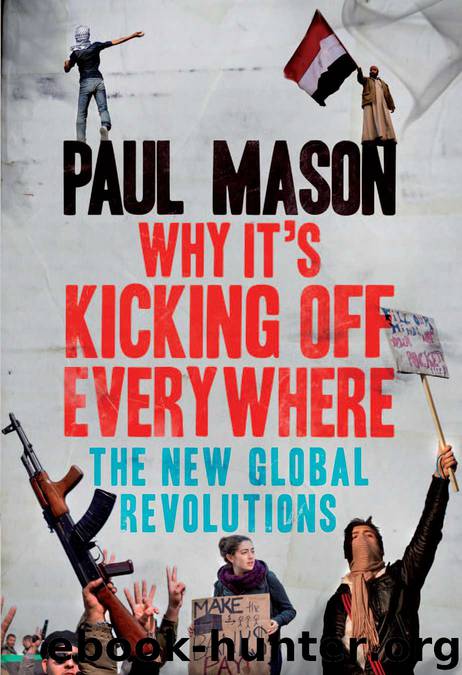
Author:Paul Mason [Mason, Paul]
Language: eng
Format: azw3
Publisher: Verso Books
Published: 2012-01-09T05:00:00+00:00
The economics of the Arab Spring
The social and political roots of the Arab Spring, and the Western myopia towards them, have been well documented. But the economic roots were, at first sight, a mystery. The experts were blindsided, in part, because the economics of the region looked positive. In 2009, growth in Tunisia bottomed out at 3 per cent; in Libya it was 6 per cent and in Egypt, 4.7 per cent. Thereafter, the economies of all three countries bounced back strongly.
On top of this, lots of other indicators looked good. Egypt had managed to pull 9 per cent of its population out of absolute poverty in the 2000s; in terms of corruption, according to Transparency International, Mubarak’s regime was on a par with Berlusconi and Hu Jin Tao’s—and certainly nowhere near the top of the global league of crookedness. On the Gini Index, which measures levels of inequality, Egypt stood level with France, Tunisia with the USA.17
But the positives masked severe structural imbalances, the most obvious symptom of which was youth unemployment. In Egypt, even before the crisis hit, 92 per cent of the unemployed were first-time job-seekers. As growth slackened, unemployment in the twenty-to-twenty-five age range rose to 28 per cent. In Tunisia it stood at 30 per cent; in Yemen, estimates put the figure at 50 per cent.18
As Arab dictators have now learned to their cost, youth unemployment is not just any old statistic to be offset by high growth, high oil prices, or a pat on the back from the IMF. It destroys human capital and spreads bitterness across society.
What was more, when the recovery came, youth unemployment did not fall back. The reasons were, again, structural: the International Labour Organization found that, in Egypt, patronage was causing three-quarters of school-leavers to wait five years to get their first job. Meanwhile, massive underinvestment in education had left 44 per cent of the workforce illiterate and more than 75 per cent lacking anything higher than middle-school qualifications. The ILO found, in other words, what you find if you hang around the edges of Tahrir Square: a smattering of graduates and a mass of chirpy, uneducated teenagers with nothing better to do than sit on somebody’s parked motor-scooter, crack jokes or join in revolutions.
When the global recovery got under way in 2010, the poor were hit by price rises, occurring in the first place because, since 2000, all global recoveries have sparked commodity price inflation; and secondly, because the USA had decided to unleash inflation onto the developing world.
As the effects of Obama’s stimulus faded, in November 2010 Ben Bernanke began a second round of money printing—$600 billions’ worth—known as ‘Quantitative Easing II’. QEII, it was recognized even at the design stage, would not increase demand directly in America. By reducing the value of the dollar, and the attractiveness of dollar investments, it would create an international ‘wall of money’ flowing out of the USA towards its emerging rivals: Russia, Brazil, India and other dynamos of the global south.
Download
This site does not store any files on its server. We only index and link to content provided by other sites. Please contact the content providers to delete copyright contents if any and email us, we'll remove relevant links or contents immediately.
| Anthropology | Archaeology |
| Philosophy | Politics & Government |
| Social Sciences | Sociology |
| Women's Studies |
The Secret History by Donna Tartt(19297)
The Social Justice Warrior Handbook by Lisa De Pasquale(12224)
Thirteen Reasons Why by Jay Asher(8998)
This Is How You Lose Her by Junot Diaz(6955)
Weapons of Math Destruction by Cathy O'Neil(6366)
Zero to One by Peter Thiel(5867)
Beartown by Fredrik Backman(5839)
The Myth of the Strong Leader by Archie Brown(5552)
The Fire Next Time by James Baldwin(5503)
How Democracies Die by Steven Levitsky & Daniel Ziblatt(5271)
Promise Me, Dad by Joe Biden(5190)
Stone's Rules by Roger Stone(5130)
A Higher Loyalty: Truth, Lies, and Leadership by James Comey(5017)
100 Deadly Skills by Clint Emerson(4972)
Rise and Kill First by Ronen Bergman(4838)
Secrecy World by Jake Bernstein(4798)
The David Icke Guide to the Global Conspiracy (and how to end it) by David Icke(4771)
The Doomsday Machine by Daniel Ellsberg(4552)
The Farm by Tom Rob Smith(4550)
